
AI-driven job disruption, rising debt, shrinking savings and a changing global economy are reshaping India's middle class. Saurabh Mukherjea discusses jobs, entrepreneurship, investing and the future of India's economic growth on THE REDIFF PODCAST.

Bangladesh is importing 5,000 tonnes of diesel from India through a cross-border pipeline on Tuesday, according to officials. The fuel consignment will enter Bangladesh through the Parbatipur point, said Muhammad Rezanur Rahman, chairman of the Bangladesh Petroleum Corporation (BPC).

Indian equities on Dalal Street declined in early trade on Monday as crude oil prices climbed amid fears of further escalation in the West Asia the war. Track Sensex, Nifty50 movement and key market drivers for Apr 6, 2026.

Authorities in Balrampur, Uttar Pradesh, have launched an inquiry after a man and his elderly mother were allegedly assaulted at a petrol pump. A video of the incident went viral, prompting swift action from local officials.
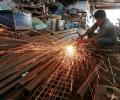
India's manufacturing sector activity reached a three-month high in May, with the HSBC India Manufacturing Purchasing Managers' Index (PMI) rising to 55.0, driven by robust domestic demand, infrastructure projects, and new business gains despite ongoing inflationary pressures.

Sensex gains over 400 points while Nifty trades above 23,800 amid strong IT sector buying.

Despite international crude oil rates crossing USD 100 per barrel due to Middle East tensions, the Indian government plans to maintain current petrol and diesel prices, ensuring uninterrupted fuel supply across the country.

Indian markets on Dalal Street rallied sharply as easing tensions in the US-Iran conflict and stable oil prices boosted sentiment. Track Nifty 50 and BSE Sensex performance and key global triggers.

Companies are already diversifying sourcing, raising prices, and reworking operating models as the disruption drags on.

Indian stock markets tumbled sharply with the Sensex falling 800 points and nearly 4 lakh crore wiped out in a single session. Here are the 6 key factors, including rupee weakness and global cues, behind the crash.
Indian benchmark indices Sensex and Nifty rebounded in early trade after three days of decline, driven by a rally in Sun Pharma following its USD 11.75 billion acquisition of US-based Organon & Co, alongside a positive trend in global equity markets.

Indian stock market indices Sensex and Nifty closed nearly 1 per cent higher, marking their third consecutive day of gains, supported by a slight decrease in crude oil prices and positive global market trends.

Tamil Nadu Petroleum Dealers' Association urged people not to panic-buy petrol or diesel, stating that 14 terminals in Tamil Nadu have enough stock to replenish 7,000-plus retail outlets as per their demand.

Shares of Oil marketing companies (OMCs) extended their gains for the fourth consecutive session on Thursday after crude oil prices plunged to six-month lows in the international markets, which boosted investor sentiments. Traders said the OMC stocks gained with crude oil prices hovering below $70 per barrel after OPEC-plus decision to increase output from April, a move which is expected to favour Indian refiners with added marketing margins on retail fuel.
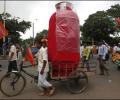
The Haryana government is taking strict measures to combat the black marketing of cooking gas cylinders, registering FIRs and seizing hundreds of cylinders. Officials assure citizens of sufficient LPG supply despite global concerns.

IndiGo operator InterGlobe Aviation had a mildly encouraging third quarter in financial year 2026 (Q3FY26).

The government has dismissed speculation of an imminent increase in petrol and diesel prices, assuring citizens that there are no plans for a hike despite rising crude oil costs.

Indian stock market benchmarks Sensex and Nifty rebounded strongly after a two-day decline, driven by falling crude oil prices and positive global cues amid hopes of de-escalation in the Middle East.
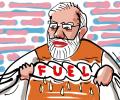
Following through announcements with enforcement of measures is key, as a run through recent Indian economic history shows, points out A K Bhattacharya.

Indian benchmark indices Sensex and Nifty experienced a sharp decline in early trading due to escalating tensions in the Middle East, driving crude oil prices higher. Global market bearishness and foreign fund outflows further contributed to investor unease.

'Even last year, when India bought gold, the physical quantity was much less than the previous years.'

The Indian government has directed oil refineries to increase LPG production to ensure a stable supply of domestic cooking gas, amidst concerns over potential disruptions from the escalating Middle East conflict and its impact on imports.

India is well-stocked with inventories of crude oil and key petroleum products, including petrol, diesel, and aviation turbine fuel (ATF), to deal with short-term disruptions as the war intensifies in West Asia, Union Minister of Petroleum and Natural Gas Hardeep Singh Puri said on Tuesday.

'Once the currency goes out of the hand, then possibly your major challenge is that it will not come back.'

Sri Lanka has established emergency hotlines and is in close contact with its diplomatic missions in West Asia following escalating tensions in the region. The country is also preparing its airports for potential flight diversions and emergencies.

India's fertiliser subsidy bill for the current financial year (FY27) is projected to increase by approximately 20% due to surging global prices, primarily driven by the West Asia crisis, a senior official confirmed. Despite this, retail prices for urea and di-ammonium phosphate (DAP) will remain unchanged, ensuring adequate supply for the kharif season.

Indian equities on Dalal Street saw volatility as global market trends and fresh tariff concerns linked to Donald Trump impacted investor sentiment. Track Sensex, Nifty50 movement and key market drivers for Feb 24, 2026.

'Once the market decides it wants to go up, it goes up -- no amount of bad news can really hold it back.'

The Quad grouping has expanded cooperation in critical minerals and energy, while unveiling new measures to boost maritime surveillance and port infrastructure across the Indo-Pacific. This move comes against the backdrop of China's growing military posturing in the region, with ministers reiterating strong opposition to destabilising actions and expressing serious concerns over militarisation of disputed features.

Prime Minister Narendra Modi convened a meeting with senior ministers to assess the impact of the evolving situation in West Asia on India's crude oil, gas, petroleum, power, and fertiliser sectors, focusing on ensuring uninterrupted supply and stable logistics.

Dabur India's stock has fallen over 17 per cent since the start of the Iran war, driven by concerns over a weak monsoon, the West Asian crisis, and rising input costs, which are expected to impact the company's revenues and margins, particularly affecting its significant rural sales and international markets.
Sri Lanka has established emergency hotlines and is closely monitoring the situation in West Asia following escalating tensions, urging restraint and de-escalation from all parties involved.

The Indian government has doubled the daily quota of market-priced 5-kg LPG cylinders for migrant workers to ensure stable fuel supplies amidst global disruptions. This move prioritises household cooking gas and addresses the needs of migrant workers who often lack regular connections.

The question is whether the clocks allow enough time for two deeply mistrustful sides to get there, and whether the surface calm holds long enough for the paddling to produce something before the ceasefire ends on April 22, notes Prem Panicker in his must read blog on the Iran War.

India's manufacturing sector experienced a mild recovery in April, with the HSBC India Manufacturing Purchasing Managers' Index (PMI) rising to 54.7 from 53.9 in March. However, inflationary pressures intensified, with input costs increasing at the fastest pace since August 2022, largely attributed to the Middle East conflict.

India significantly increased piped natural gas (PNG) connections in March as the government accelerates the expansion of cleaner fuel networks amid global supply disruptions.
India's private sector activity saw a significant recovery in April, driven primarily by robust growth in manufacturing output and sales, following a three-year low in March attributed to the West Asia conflict.
The government has sharply reduced excise duty on petrol to 3 and diesel to zero, offering major relief to consumers. Here's how the price cut will impact fuel rates and inflation.

India's peak power demand is projected to hit 270 GW this summer, surpassing last year's record of 250 GW.

America's population and its media and its democratic structures seem fine with this, which is why Trump continues as he does, asserts Aakar Patel.
